
“ THE SECRET DOCTRINE”
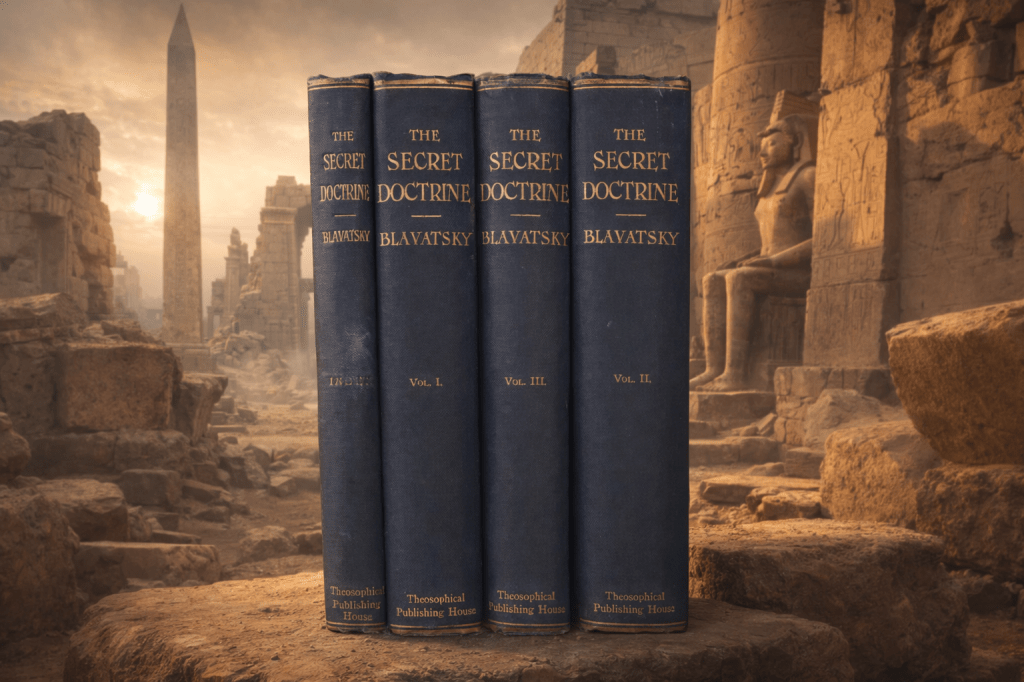
THE Adyar Edition of The Secret Doctrine was officially published on the 17th November 1938 at the Founders’ Day celebration in the Great Flail, Adyar. The President introduced the set of six volumes, saying : “ I am very happy to make this act of reverence to H .P. Blavatsky, the great mother of our Movement, the one to whom we owe more than any other of our leaders. It is a very happy thing that we have this Adyar Edition, named as she would have wished it, and in reverence we dedicate it to her memory, in the present and in the future.” The President announced that 800 copies had been ordered before publication.
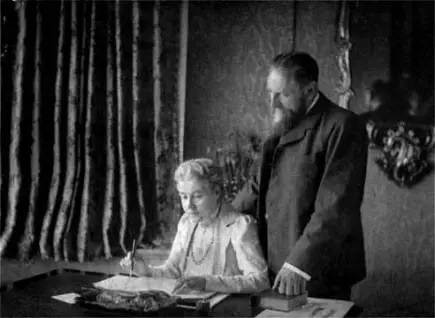
It chimes in harmoniously with the launching of this Adyar edition to reproduce in this issue (see next page) the review of The Secret Doctrine which Dr. Besant wrote fifty years ago. Mme. Blavatsky published the first two volumes in October 1888. Early in 1889 W.T. Stead asked Annie Besant to review it, and her review appeared in The P all M all G azette, of which he was Editor, on April 25. The incident is related by Dr. Besant in her Autobiography (pages 339-340), where she describes the intellectual conflict through which she was passing and her diligent search for answers to questions that were working in her mind :
“Mr. Stead gave into my hands two large volumes. “ Can you review these ? My young men all fight shy of them, but you are quite mad enough on these subjects to make som ething of them ” . . . .
Home I carried my burden, and sat me down to read. As I turned over page after page the interest became absorbing; but how familiar it seemed; how my mind leapt forward to presage the conclusions, how natural it was, how coherent, how subtle, and yet how intelligible. I was dazzled, blinded by the light in which disjointed facts were seen as parts of a mighty whole, and all my puzzles, riddles, problems, seemed to disappear. The effect was partially illusory in one sense, in that they all had to be slowly unravelled later, the brain gradually assimilating that which the swift intuition had grasped as truth. But the light had been seen, and in that flash of illumination I knew that the weary search was over and the very T ruth was found.”
In the midst of writing this review Mrs. Besant wrote to Mr. Stead : “ I am immersed in Mme. Blavatsky! If I perish in the attempt to review her, you must write on my tomb ‘ She has gone to investigate the Secret Doctrine at first hand “*
Two months later (June 23) Mrs. Besant wrote another review for The N ational Reformer, Charles Bradlaugh’s paper. She mentions it in her Autobiography, quoting some passages as showing “ how swiftly some of the main points of the teaching had been grasped.” We will reproduce the full text of the National Reformer review in our next issue.
Among the Adepts
MADAM BLAVATSKY ON THE SECRET DOCTRINE
The Famous Review by Annie Besant
From the “Pall Mall Gazette,” 2th April 1889
“It was the writing of this review of The Secret Doctrine which convinced Annie Besant of the truth of Theosophy and brought her into the movement. She asked Mr. Stead for an introduction to the writer, and then sent a note asking to be allowed to call. In reply Mme. Blavatsky wrote, 15th March 1889 : “ I too have long been wishing to make your acquaintance as there is nothing in the world I adm ire more than pluck and the rare courage to come out and state one’s opinions boldly in the face of all the world, including Mrs. G rundy.” (This letter is in the Adyar Archives.)”
A remarkable book
IT would be difficult to find a book presenting more difficulties to the “ reviewer with a conscience” than these handsome volumes bearing the name of Mme. Blavatsky as author—or, rather perhaps it would be more accurate to say as compiler and annotator. The subject matter is so far away from the beaten paths of literature, science and art; the point of view so far removed from our occidental fashion of envisaging the universe; the lore gathered and expounded so different from the science or the metaphysics of the West, that to ninety-nine out of every hundred readers—perhaps to nine hundred and ninety-nine among every thousand—the study of the book will begin in bewilderment and end in despair.
Let it be said at once that the great majority of average easy-going folk will do well not to begin the “ Secret Doctrine ” at all. A certain mental position must be acquired ere any reading thereof can be aught save weariness and futility. The would-be reader must have an intense desire to know, and to know not merely the relation between phenomena, but the causes of phenomena ; he must be eagerly searching for that bridge between matter and thought, between the vibrating nerve-cell and pecipiency which the late Professor Clifford declared had never yet been thrown across the gulf that sunders them; he must be free from the preposterous conceir (that exists now as realy for the physical universe as it did in the days of ceopernicus for the physical) that this world and its inhabitants are the only inhabited world and the only intelligent beings in the universe; he must recognize that there may be, and most probably are, myriads of existences, invisible, inaudible to us, because we have no senses capable of responding to the vibrations that they set up, and which are therefore nonexistent to us, although in full activity, just as there are rays at either end of the solar spectrum quite real as the visible rays although invisible to us. If only the nerve ends of our eyes and ears could respond to higher and lower rates of vibration, who can tell what new worlds, more and less “material” than our own, might not flash into our consciousness, what sights and sounds might not reach us from spheres interblended with our own? A deep sea fish, awared that his comrades might explode if they were dragged to the surface, and knowing naught of life-conditions other than his own, might, if he were a rash deep-sea fish deny the possibility of other intelligent beings inhabiting the upper regions of the sea or the land invisible to him. And so we may, if we are rash , deny all lives save those led on our globe at the bottom of our ocean, and human deep-sea fishes had better leave Mme. Blavatsky’s volumes alone.
None the less is her book at onces remarkable and interesting remarkable for its wide range of curious and ancient lore, interesting for the light it throws on the religions of the world. For as she unrolls the Secret doctrine we catch sight of familiar faces in the imagery that passes under our eyes, now Egyptian, and now Jewish, now Persian, and now Chinese, now Indian, and now Babylonianish, until slowly the feeling grows up that she is showing us the rock whence all these faiths were hewn, the complete cosmogony whereof these have presented disjointed fragments. Inevitably the question arises: “Have we here, from the Aryans who rocked the cradle of the world’s civilization , the source of all the master-religions as well as of the master-races of the earth?”
Cosmic Evolution
The first volume of The Secret Doctrine is divided into three parts—an exposition of Cosmic Evolution, of the Evolution of Symbolism, and of the contrast between Science and the Secret Doctrine. Of these, the first will most repel and the third will most attract. For the first is a metaphysical treatise wherein the Hindu brain, subtlest and most mystic of all mental organisms, expounds Being and the beginning of beings in a fashion that no Western intellect can rival. The causeless Cause, the rootless Root, whence spirit and matter alike differentiate, is the One Existence—hidden, absolute, eternal, indistinguishable by us from non-existence in that it has no form that can enable us to cognise it. From this all that exists proceeds; in itself Be-ness—why not Existence?—then Becoming, and the Becoming alone can be intelligible to us. From this one primal element, whereof all phenomena are transmutations, there is then a hierarchy of existences in linked order, the gradual evolution of a universe. In reading this “origin of things,” as in reading all others, there is the constant feeling of unsatisfied desire for evidence, despite the sweep of conception and the coherency of the whole. Of course the claim set up is that this Secret Doctrine comes from those who know—know with scientific certainty, not with mere guess and groping—from the Arhats, the Wise Ones of the East, whose disciple Mme. Blavatsky claims to be. But then we crave for some proof of these revealers. As regards the metaphysics, here again there is the feeling of the breakdown of language, the contradictions in which the mind is involved when it strives to grasp the ever-elusive ultimates of being. However flexible and subtle in its shades of meaning Sanskrit may be, our Occidental tongues at least stumble into maddening confusion amid the shadowy forms and no forms of the Thing in Itself. And when it comes to symbolizing existence as a boundless circle—using a word that implies limitation and is empty of meaning without it—in connection with the absence of limitation, what can one do save admit that we have passed out of the region in which language is useful as conveying concepts, and that before the mystery of existence silence is more reverent than self-contradictory speech?
Very briefly and roughly put, the idea is that Be-ness evolves spirit and matter, spirit descending further and further into matter in search of experiences not otherwise attainable, evolving all forms. It reaches the lowest point, commences its re-ascent, evolves through mineral, vegetable, and animal until it attains self-consciousness in man. Then in man, with his sevenfold nature, it climbs upward, spiritualizing him as he evolves, until the grosser body and the animal passions are purged away, and his higher principles united to Atma, the spark of the divine spirit within him, reach their goal—the absolute existence whence they originally came, carrying with them all the gains of their long pilgrimage. This process implies, of course, manifold reincarnations for each human spirit as it climbs the many steps at whose summit alone is Rest. Only when a certain height is touched comes memory of the past, and then the purified spirit can gaze backwards over the stages of its ascent.
Science and Occultism
Passing over Part II on Symbolism, we find Mme. Blavatsky, in Part III, in full tilt against modern science—not as against its facts, but as against its more recondite theories. It is an easy task for her to show that great scientific thinkers are at issue with each other as to the constitution of the ether, the essence of “matter” and of “force,” and she claims that the Occultist has the knowledge after which the scientist is only groping, and that at least, among the warring theories, Occultism may demand a hearing. Some of the theories now put forward indeed come very near to occult views and make scientifically possible some of the startling manifestations of occult power. Newton’s view, for instance, that gravity must be caused by an agent acting constantly according to certain laws, is in unison with the Occultist’s assertion that all the forces in nature are actions of intelligences working ceaselessly—though invisibly to us—in the universe. Much of the speculation of Butlerof and Crookes almost touches occult teaching. The Akasa of the Occultist is, as it were, the “matter-force” after which science is groping, the parent of all phenomena. Within our terrestrial sphere, on the plane of the universe accessible to our physical senses, science is accurate as to vibrations and so on. Where it fails, says the Occultist, is in supposing that these are all—that on these lines of investigation can ever be discovered the nature, say, of light or colour. There are planes above ours on which matter exists in other modifications, in other conditions. On those must be sought the causes whereof science studies the effects—the true nature of our physical phenomena. The atom, that strange conception of the physicist, elastic yet indivisible, is to the Occultist a soul, “a centre of potential activity” differentiated from the One Soul of the universe, “the first-born of the ever-concealed Cause of all causes,” building up the visible universe. Instead of matter “inert” and “inanimate,” clashing through eternities, flinging up here a sun and there a world, and finally evolving thought, the Occultist sees Intelligence robing itself in matter, energizing, guiding, controlling, animating all that is. The antithesis could not be sharper, and one or other solution of the problem of problems must be accepted by the philosopher. Which?
Civilization
The second volume of Mme. Blavatsky’s work deals with man, the first part being occupied with his genesis, the second with the symbolism of his religions, the third with the contrast between the occult and the scientific views of his evolution. Of these, the first will be met with the most furious and contemptuous resistance, for briefly this is the theory: Man as he is now, with his sevenfold nature—physical body, vital principle, astral body, animal soul, human or rational soul, human spirit, divine spirit—was not created offhand complete. The First Race was created, breathed out of their own substance by the beings who built our world, and was spiritual, ethereal, sexless, and of slight intelligence. The Second Race was produced by gemmation from the First, more material than its progenitor and sexual. The Third Race was produced oviparously, and among these separation of the sexes appeared gradually, the earlier being androgynous, the later distinctly male and female. The intellectual development was still very low, for spirit had not yet become sufficiently clothed with matter for self-conscious thought. Of this race in its later stages were the dwellers in Atlantis and the Lemurians. Among them arose the birth of religions, astronomical and sexual, and of these was born the Fourth Race—the giants, the “men of renown”—in whom we touch the “purely human period.” (A curious excursus on the “third eye” which occurs here receives remarkable confirmation from some of the latest scientific speculations on the pineal gland.) Now begins civilization and the building of the great rock cities, and the physical and intellectual nature of man develops “at the cost of the psychic and the spiritual.” The huge statues and other remains found in Easter Island, Bamian, and other spots bear witness to the size of their makers, as do the vast dwellings and the enormous human bones of Misorte. With the Fifth Race we pass into the domain of history, and to this the present races of men belong. Far away as, at first sight, all this seems from Occidental science, yet the careful reader will mark the curious analogies between this occult view of human evolution and the scientific view of the evolution of living things on our globe—an evolution still shown in broad outline in the individual development of each human being from ovum to man.
Mme. Blavatsky’s views may not meet with acceptance, but they are supported by sufficient learning, acuteness, and ability to enforce a respectful hearing. It is indeed the East which through her challenges the West, and the Orient need not be ashamed of its champion. We have here but given a few fragments of her lore, and injustice is necessarily done by such treatment to the whole. The book deserves to be read; it deserves to be thought over. None who believes in the progress of humanity has the right to turn away over-hastily from any contribution to knowledge, however new in its form, from any theory, however strange in its aspect. The wild dreams of one generation become the commonplaces of a later one, and all who keep an open door to Truth will give scrutiny to any visitant—be the garb of Asia or of Europe, be the tongue of Paris or of Ind. If this counsel be of folly or of falsehood it shall come to naught; but if of Truth you cannot overthrow it. Passing strange is it. Of the truth in it our superficial examination is insufficient to decide.
Source: The Theosophist, (1939), “Annie Besant’s Famous Review of “The Secret Doctrine,” January Vol. LX, No. 4, pg: 261-266.
 lightofluxor.com