
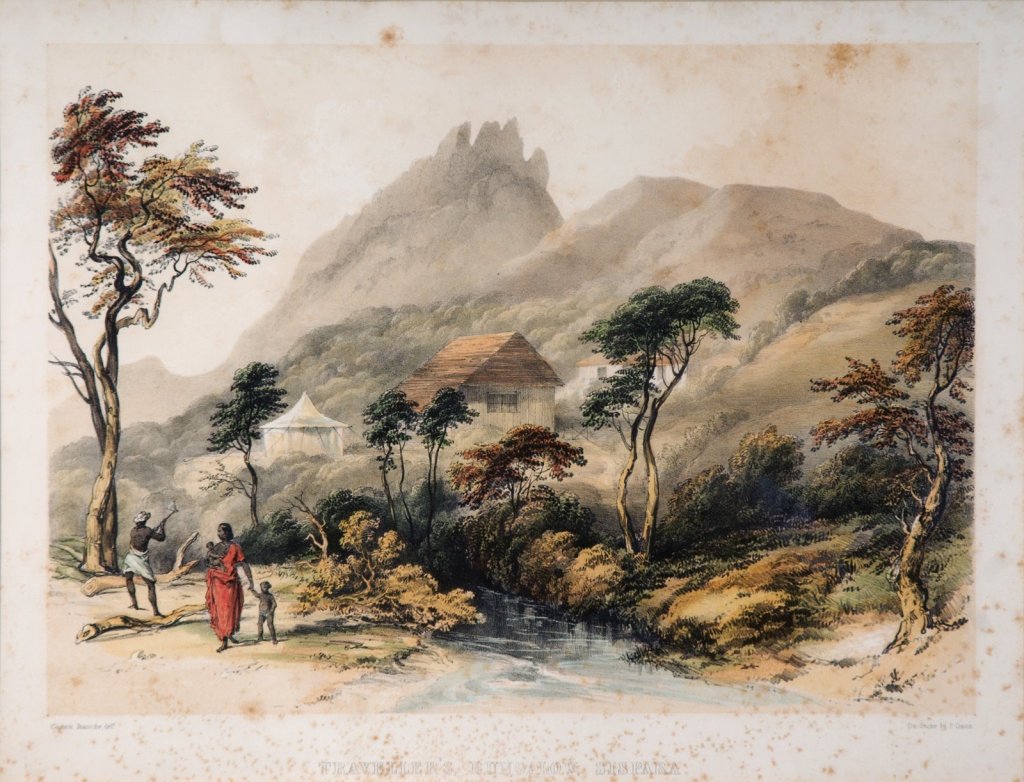
Painting by Captain Stephen Ponsonby Peacocke 1847, Sispara, Nilgiri Hills, Tmail Nadu India, travelers bungalow.
I was told that Sannyasis were sometimes met with on a mountain called Velly Mallai Hills, in the Combatore District, and trying to meet with one, I determined to ascend this mountain. I travelled up its steep sides and arrived at an opening, narrow and low, into which I crept on all fours. Going up some twenty yards I reached a cave, into the opening of which I thrust my head and shoulders. I could see into it clearly, but felt a cold wind on my face, as if there was some opening or crevice- so I looked carefully, but could see nothing. The room was about twelve feet square. I did not go into it. I saw arranged round its sides stones one cubit long, all placed upright. I was much dis- appointed at there being no Sanyasi, and came back as I went, pushing myself backwards as there was no room to turn. I was then told Sanyasis had been met with in the dense sholas (thickets), and as my work lay often in such places, I deter- mined to prosecute my search, and did so diligently, without, however, any success.
One day I contemplated a journey to Coimbatore on my own affairs, and was walking up the road trying to make a bargain with a bandy man whom I desired to engage to carry me there; but as we could not come to terms, I parted with him and not gone far when I met a man dressed like a Sanyasi, who stopped and spoke to me. He observed a ring on my finger and asked me to give it to him. I said he was welcome to it, but inquired what he would give me in return. He said, “I don’t care particularly about it; I would rather have that flour and sugar in the bundle on your back.” “I wil give you that with pleasure,” I said, and took down my bundle and gave it to him. ” Half is enough for me,” he said; but sub. sequently changing his mind added, ” now let me see what is in your bundle,” pointing to my other parcel. ” I can’t give you that.” He said, ” Why cannot you give me your swami (family idol)?” I said, ” Itis my swami, Iwil not part with it; rather take my life.” On this he pressed me no more, but said, “Now you had better go home.” I said, ” I will not leave you.” “Oh you must,” he said, ” you will die here of hunger.” ” Never mind,” I said, ” I can but die once.” ” You have no clothes to protect you from the wind and rain; you may meet with tigers,” he said. ” I don’t care,” I replied. ” I t is given to man once to die. What does it signify how he dies?” When I said this he took my hand and embraced me, and immediately I became unconscious. When I returned to consciousness, I found myself with the Sanyasi in a place new to me on a hill, near a large rock and with a big shola near. I saw in the shola right in front of us, that there was a pillar of fire, like a tree almost. I asked the Sanyasi what was that like a high fire. “Oh,” he said, ” most No,” I said, ” it is not like any common fire there is no smoke, nor are there flames-and it’s not lurid and red. I want to go and see it.” “No, you must not do so, you cannot go near that fire and escape alive.” “Come with me then,” I begged. “No–I cannot,” he said, “if you wish to approach it, you must go alone and at your own risk; that tree is the tree of knowledge and from it flows the milk of life: whoever drinks this never hungers again.” Thereupon I regarded the tree with awe.
I next observed five Sannyasis approaching. They came up and joined the one with me, entered into talk, and finally pulled out a hookah and began to smoke. They asked me if I could smoke. I said no. One of them said to me, let us see the swami in your bundle here gives a description of the same). I said, ” I cannot, I am not clean enough to do so.” ” Why not perform your ablutions in yonder stream?” they said. ” I f you sprinkle water on your forehead that will suffice.” I went to wash my hands and feet, and laved my head, and showed it to them. Next they disappeared. ” As it is very late, it is time you returned home,” said my first friend. ” No,” I said, “now I have found you I will not leave you.” “No, no,” he said, “you must go home. You cannot leave the world yet; you are a father and a husband, and you must not neglect your worldly duties. Follow the footsteps of your late respected uncle; he did not neglect his worldly affairs, though he cared for the interests of his when you get your fortnightly holiday.” On this he embraced me, and I again became unconscious. When I returned to myself, I found myself at the bottom of Col. Jones’ Coffee Planta- tion above Coonor on a path. Here the Sanyasi wished me farewell, and pointing to the bigh road below, he said, “Now you will know your way home;” but I would not part from him. I said, ” All this will appear a dream to me unless you will fix a day and promise to meet me here again.” ” I promise,” he said. “No, promise me by an oath on the head of my idol.” Again he promised, and touched the head of my idol. ” Be here,” he said, ” this day fortnight.” When the day came I anxiously kept my engagement and went and sat on the stone on the path. I waited a long time in vain. At last I said to myself, ” I am deceived, he is not coming, he has broken his oath “-and with grief I made a poojah. Hardly had these thoughts passed my mind, than lo! he stood beside me. ” Ah, you doubt me,” he said; ” why this grief.” I fell at his feet and confessed I had douhted him and begged his forgiveness. He forgave and comforted me, and told me to keep in my good ways and he would always help me; and he told me and advised me about all my private affairs without my telling him one word, and he also gave me some medicines for a sick friend which I had promised to ask for but had forgotten. This medicine was given to my friend and he is perfectly well now.
Five years of Theosophy, (1885), “The Nilgiri Sannyasis,” A verbatim translation of a Settlement Officer’s statement, E.H. Morgan, London Reeves & Turner 196 stramd WC, 1885, pg: 72-75.
 lightofluxor.com