
By Julian Ochoa
This Article was first published in The Light of Luxor Independent Theosophical Magazine, Vol. 3. 2021.

Famous occultists have always been known to have talismans, jewels, rings and necklaces that give them power, or a particular status based on its symbolism. In modern occult circles, the most famous jewels that have captivated audiences interested in such topics, are those that the historical Freemason, Count Cagliostro possessed. Count Cagliostro was an 18th Century figure, he was famous for his mysterious origins, his masonic activities, his connections to the 18th century European Royalty, and for his dealings with notable people like Benjamin Franklin, Louis Claude de St. Martin, and other occult adepts known in masonic circles as the Unknown Superiors. Cagliostro was registered to have passed away at the fortress of St. Leo in 1791 after having been tried by the Holy Inquisition. His legacy was that of mystery, and awe, on the other hand, his detractors ensured his name would remain for ever tainted with misinformation. Cagliostro has been loved by many and has also been an object of laughter. What many people does not know, is that he left not only a Freemasonic Egyptian Ritual which has now been republished in the book the Masonic Magician, by Philippa Faulks and Robert L.D. Cooper, but he has also left artefacts which are held in different private estates and museums. The most famous of his artefacts, are the scarab ring, which is kept in a museum in London, the second one is the Kabbalistic knife which was sold in an auction in 2003 and the last of his known artefacts is the Cagliostro Jewel, which was given to H.P. Blavatsky by one of her Masters. The Cagliostro Jewel has a story of its own, and it is this jewel which this paper will focus on.
The journey of the Cagliostro jewel as it is known at present started with Blavatsky. A more recent owner of the jewel, Rukmini Arundale, was recorded saying that Blavatsky received the jewel directly from Cagliostro`s Master, The Prince.[1] Another way by which Blavatsky could have received the jewel was through a connection to her Master, in the letters from Blavatsky to A.P. Sinnett, Blavatsky mentions that a disciple of her Master visited Count Cagliostro at the fortress of St. Angelo in Italy; the fortress of St. Angelo is where it is said Cagliostro Passed away in solitary confinement. One of the Master`s Disciple, Darbargiri Nath, visited Cagliostro for about an hour.[2] Until Blavatsky`s recounting of this story, it was unknown by The Vatican authorities who this visitor was, Dadrbaghiri Nath is still unknown outside theosophical circles.
Upon the death of Blavatsky in 1891, the Cagliostro jewel passed into the custody of Col. Henry S. Olcott, President-Founder of the Theosophical Society. He allowed Annie Besant to wear the Jewel. There are some photographs of Mrs Besant wearing the jewel. However, Col. Olcott stipulated in his Will that the Cagliostro Jewel should be returned to the TS Museum at Adyar upon her death. When George Arundale was writing the book The Lotus Fire, Arundale asked Dr. Besant, if he could borrow the Jewel so that its influence may help him in writing the book. When Dr Besant died, in 1933, George Arundale still had in his possession the Jewel, which, after his death in 1945, passed into the hands of his wife, Rukmini Devi Arundale. Various Presidents of the TS, including C. Jinarajadasa, N. Sri Ram and John Coats, had written letters to Mrs Arundale, on behalf of the General Council of the TS, requesting her to return the Jewel to the TS Museum at Adyar, as was determined in Col. Olcott’s Will. Mrs Arundale claimed that Dr Besant had gifted the Jewel to her. She kept the jewel until her passing in 1986. In 1992, Pedro Oliveira, then International Secretary of The Theosophical Society, obtained the jewel from the Kalakshetra Foundation in Chennai. Mr. Oliveira wrote the following statement regarding the return of the Jewel to the Theosophical Society:
“The Cagliostro Jewel Returns to Adyar“
“In March 1992 I went to live at the International Headquarters of the Theosophical Society at Adyar, Madras (now Chennai), India. There I worked as international Secretary until October 1996.
Some time after my arrival I was asked to seek an appointment with Mr K. Shankara Menon, then President of Kalakshetra – College of Fine Arts, in order to request that the Cagliostro Jewel be returned to the Society, as Col. Olcott, our President-Founder, had bequeathed it in his will to the TS.
Early in July 1992 I went to Kalakshetra campus in Tiruvanmiyur, near Adyar, and met Mr Shankara Menon, who welcomed me as a gentleman. He told me there was a dispute about the jewel and that it had been kept in a bank safe. But he said he would give it to me to be returned to the Theosophical Society. He then asked me to bring to him a formal letter of request. In the meantime he would see that the jewel was brought from its safe to him.
On 17 July 1992 I went again to Kalakshetra, this time with a formal letter of request, written in the letterhead of the TS. Once more Mr Shankara Menon gently welcomed me. He showed me the case containing the jewel and opened it. I could then ascertain that the jewel was inside. He then dictated a receipt, with a copy, to his secretary. I signed the receipt and he gave me the jewel, after which I thanked him on behalf of the Theosophical Society. I went back to the International Headquarters and handed over the jewel to the person in charge of the Museum and Archives.”
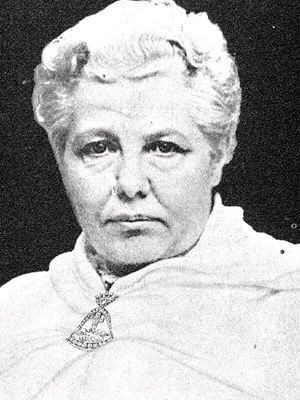
Annie Besant Wearing the Cagliostro Jewel
The Cagliostro Jewel symbolises the Freemasonic 18° of the Ancient and Accepted Scottish Rite, also known as the Rose Croix degree, the jewel is composed of the Rose Croix symbol of the Pelican feeding its babies, symbolizing Jesus sacrificing himself for God and Humanity, The cross is also represented in the jewel symbolising the Christian and Universal aspects of the Rose Croix degree, The Compasses is the instrument, of the Master of the Temple with which he designs the perfect temple.[3]
In conclusion the Cagliostro jewel is a relic of the Freemasonic and Theosophical world. Not only did Cagliostro leave a legacy in the masonic mythos, Blavatsky mentioned him several times in her writings and inherited his jewel which today is kept in theosophical hands as it was intended the moment the jewel was given to her.
Reference list
- Barker, A.T. “The Letters of H.P. Blavatsky to A.P. Sinnett,” T. Fisher UNWIN LTD, LONDON, (1925).
- Lomas, R. “The Secret Power of Masonic Symbols,“ Fairwinds Press (2011).
- Taylor, Nell C. “The Mysterious Life And Transitions Of The Cagliostro Jewel,“ Theosophical History a Quarterly Journal of Research, Vol. 3 No. 3, (July 1990).
[1] Taylor, Nell C. “The Mysterious Life And Transitions Of The Cagliostro Jewel,“ Theosophical History a Quarterly Journal of Research, Vol. 3 No. 3, (July 1990) pg. 82.
[2] Barker, A.T. “The Letters of H.P. Blavatsky to A.P. Sinnett,” T. Fisher UNWIN LTD, LONDON, (1925), pg:78.
[3] Lomas, R. “The Secret Power of Masonic Symbols,“ Fairwinds Press (2011) pg: 144.
 lightofluxor.com